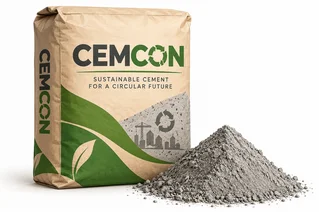
This project transforms recycled concrete fines (RCFs) from construction and demolition (C&D) waste to be used as supplementary cementitious materials (SCMs), thereby converting these fine concrete wastes into cement (CEMCON). The main objectives are to characterize and categorize RCFs from various recycling plants, develop a treatment method to activate different types of RCFs, and understand the performance and environmental impacts of these activated RCFs when used as SCMs.
Link to Project Webseite
Funding information
CEMCON: Marie Skłodowska-Curie Actions (MSCA)
Project partners
everox
Involved Persons
Rajaprharshini Perumaiya Raja, Priyadl
Contact
Rajapriya Raja
The mechanisms of continuous refractory wear are investigated and quantified to determine material-specific wear parameters. This understanding forms the basis for developing new refractory materials for industrial applications and helps reduce costs, the consumption of raw materials and energy, and the volume of worn material generated.
Link to K1-MET Metallurgisches Kompetenzzentrum
Funding Information
COMET: Competence Centers for Excellent Technologies der Österreichischen Forschungsförderungsgesellschaft (FFG)
Project partners
JKU- PFM, K1-Met GmbH, RHIM GmbH, Voestalpine
Involved Persons
Sandra Vollmann, Jeronimo Guarco, Burhanuddin, Christian Schober
Contact
Sandra Vollmann
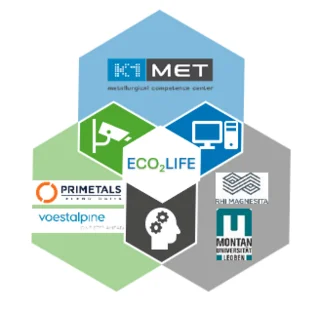
ECO2LIFE is developing new methods for the monitoring, modelling and predictive maintenance of BOF converters (Basic Oxygen Furnaces). The aim is to better understand the degradation mechanisms affecting the refractory lining and steel shell, detect critical damage early, and derive targeted maintenance measures. To this end, existing process and sensor data are combined with innovative measurement methods. The data is processed and used to validate detailed thermal and thermo-mechanical finite element models of the refractory lining and the steel shell.
Link to K1-MET Metallurgisches Kompetenzzentrum
Funding Information
Produktion und Material 2023, Forschungsförderungsgesellschaft (FFG)
Project partners
K1-Met GmbH, RHIM GmbH, Voestalpine, Primetals Technologies
Involved Persons
Dietmar Gruber, Thomas Duminy
Contact
Dietmar Gruber
REFFRACTEUR develops new digital, sustainable and circular solutions for refractory materials, which are essential in energy-intensive high-temperature processes such as steel, cement, glass and non-ferrous-metal production. The project brings together materials science, process and mechanical engineering, digital technologies and sustainability assessment. Its objective is to improve the understanding, design, use and high-value recycling of refractory materials throughout their entire life cycle. To achieve this, REFFRACTEUR combines digital product passports, life-cycle assessment, sensor-based quality control, artificial intelligence and digital twins.
Through this integrated approach, the project aims to reduce raw-material and energy consumption, CO₂ emissions, waste volumes and costs. REFFRACTEUR therefore contributes to a resource-efficient, safe, competitive and resilient European process industry.
Link to REFFRACTEUR
Funding Information
This project has received funding from the European Union's Horizon Europe research and innovation program under grant agreement no. 101312113
Project partners
Involved Persons
Dietmar Gruber, Kali Undamatla, Neilson Abad
Contact
Dietmar Gruber
Investigations into low-CO2, recyclable insulation materials made of mineral foam
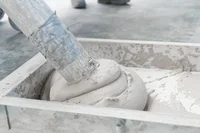
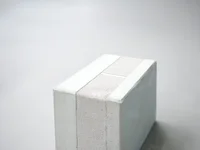
The demand for climate-friendly, recyclable, CO₂-reduced building materials is growing rapidly in view of the climate crisis, resource scarcity and stricter regulations (e.g. life cycle balances, circular economy). The construction sector is a major contributor to global emissions; the lever over materials with a low CO2 footprint, long service life and high recyclability is correspondingly large. Against this background, the Chair of Mineral Metallurgy is researching the optimisation of sustainable insulation materials based on mineral foam.
Mineral foam is a porous, mineral insulation material that is produced from resource-efficient components such as sand, lime and cement-bound systems through a drifting and foaming process. It is non-flammable, permeable to diffusion and capillary-active, which makes it particularly safe and robust in terms of building physics. Compared to many synthetic alternatives, an all-mineral matrix offers advantages in fire protection, ageing resistance and potential recyclability. In addition, the material proximity to mineral building products will enable better integration into cycles in the future – from the use of secondary raw materials to high-quality recycling at the end of life.
Our research focus is on low-CO₂ formulation development and optimization. We integrate CO₂-reduced binders and explore the influence of other additives without sacrificing thermal performance or compressive strength. The key levers are a deep understanding of the interaction of the raw materials, the control of foam stability and a stable, not too narrow process window for further processing.
In a project cooperation with Miralis GmbH, we are bundling scientific and industrial expertise in order to transfer the developed mineral foam systems to an industrial scale. Together, we work on the scale-up steps from recipe optimization to continuous foam generation and shaping to drying and quality assurance. In doing so, we are testing the use of secondary raw materials to further reduce the carbon footprint and evaluating alternative formulation components to ensure supplier independence.
The goal is a high-performance, industrially scalable and recyclable mineral foam with a significantly reduced CO₂ footprint – an insulation material that meets the technical requirements of modern building envelopes and at the same time accelerates the transformation towards a sustainable, resource-saving construction industry. The cooperation with Miralis GmbH enables rapid validation on a pilot and pre-series scale and creates the basis for a rapid market launch.
Contact: Christina Atzenhofer
MINREC-HT
Innovative sorting and recycling processes for mineral residues for valorization in high-temperature applications.
The industry is faced with the task of conserving natural resources, reducing landfill costs and operating more sustainably. At the same time, many mineral residues such as construction waste, slag, furnace breakouts or refractory production waste remain unused – even though their chemical composition predestines them for use as secondary raw materials. This is where MINREC-HT comes in: The project records and characterises these material flows and prepares them in a targeted manner using combined mechanical, thermal and chemical processes in order to reintroduce them into industrial cycles.
The central goal is the extraction of high-quality secondary raw materials for high-temperature applications, such as the production of binders and water glasses in the refractory industry. Separated fractions without HT potential are also analysed and fed into existing recycling paths. Technological developments are linked to comprehensive sustainability assessments in order to take ecological, economic and social effects into account holistically. In this way, the project contributes to CO2 reduction, resource conservation and a zero-waste approach along energy- and emission-intensive processes in the steel, cement and refractory industries.
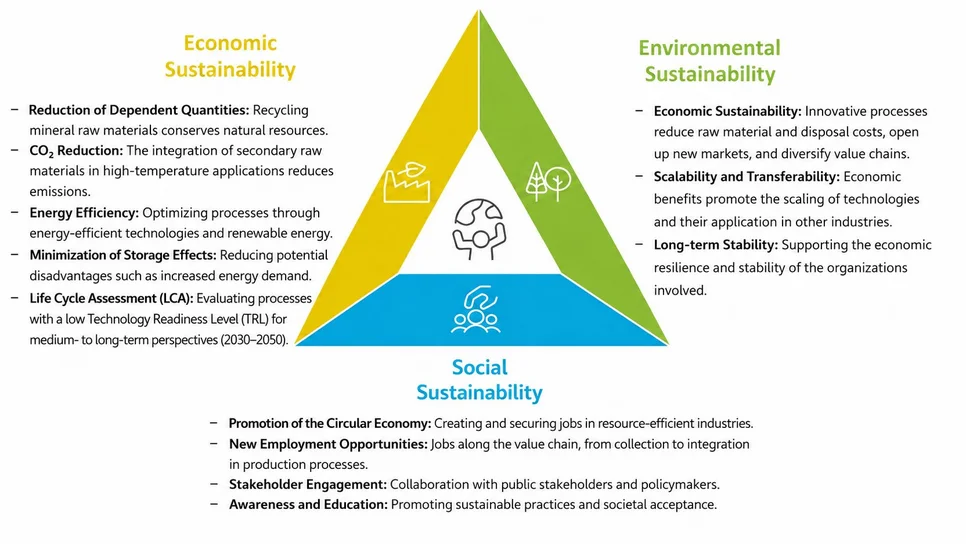
The consortium brings together leading science and industry for consistently sustainable value creation: Montanuniversität Leoben (Chair of Thermal Processing Technology, Chair of Waste Processing Technology and Waste Management and Chair of Building Materials and Ceramics) advances recycling technologies, the circular economy, and refractory materials; TU Graz strengthens material characterization and sustainable construction materials (Institute of Materials Testing and Building Materials Technology, and Applied Geosciences); and TU Wien (Institute of Chemical, Environmental and Bioscience Engineering) is responsible for the sustainability assessment. The industry partners Holcim (Österreich) GmbH, BRM Recycling GmbH, Brantner Österreich GmbH, Breitenfeld Edelstahl AG, RHI Magnesita GmbH, and Next Generation Elements GmbH (NGE) implement the results in practice.
The Chair of Building Materials and Ceramics is responsible for thermochemical simulation of high-temperature behavior to identify thermally relevant process parameters for processing. Based on the valorized materials, formulation concepts for binders are developed, and refractory-relevant microstructures are derived and produced. These are then characterized in an application-oriented manner to specifically assess their suitability for high-temperature applications.
FFG database: https://projekte.ffg.at/projekt/5145339
The MINREC-HT project is funded under the national “Resource Transition 2025” call by the Federal Ministry for Innovation, Mobility and Infrastructure (BMIMI). Administration is carried out by the Austrian Research Promotion Agency (FFG). www.fti-ressourcenwende.at